Friday, October 31, 2014

Taking God to Work


When it comes to work, no matter what job you have, those of us who call ourselves Christians often have a disconnect between our Christian life and our work life. And even if there’s not a disconnect between the two, at least there’s a tension there and we’re not sure how to bring our faith into our job.

But we serve a God who created us to work and loves it when we work. So for the next four weeks we're going to discover what God says about work and we would love for you to join us, Sundays at 10 AM at Spartan 16 Movie Theater.

Monday, October 27, 2014

Being different


Not only do the accents sound awesome, but this something I've been thinking about for years. 


How can we be different from the world around us? 


I don't think being different equates to being against. But the call is clear for those of us who call ourselves Christians are called to be different. 


I'd love to hear your thoughts.

Wednesday, October 22, 2014

Thoughts on worship


I shared a few thoughts on worship this past Sunday. Thought I'd repost them here.

Worship is active, not passive. Sometimes we approach the time of worship and singing as we would a concert where the professionals perform for us and we are passive listeners. I don’t think that makes God smile at all. Worship is always active and participatory. I like to think of it this way: God is the audience. We're the performers. 

Worship is both individual and corporate. Yes, we can worship by ourselves. We need to do that. But we also need to worship with one another. Something supernatural happens when followers of Jesus worship their Lord and Savior together.

Worship involves way more than singing. Singing is an expression of worship, but it's not the only expression of worship. We also worship through service, and giving, and taking communion, and listening, and obeying what God tells us to do in his word.

Worship overflows from a growing relationship with God. The catch is that it's impossible to grow in our relationship with God if we're not reading, meditating on, memorizing and obeying what God tells us in the Bible. Reading the Bible is like breathing in. Worship is like breathing out.

Join us this coming Sunday at Hub City Church for a morning of worship. 10 AM Spartan 16 Movie Theater.

Tuesday, October 21, 2014

The book that made your world

I mentioned this book on Sunday and wanted to put a link to it here. It's a bit difficult to read, but well worth pushing through the difficulty. 

Now, why would it be worth it to push through the difficulty and read this book? 

I believe that reading the Bible has value whether your believe it or not. This book is a sort-of history of the influence of the Bible on the world we live in. 

I also think it gives us a glimpse of what the world is going to look like if we rid it of the the Bible's influence. Suffice to say, it's not a world that you will want to live in.

Friday, October 10, 2014

The most dangerous soundtrack of all

This coming Sunday at Hub City Church I'm going to be talking about the Soundtrack of worry.

Everybody I know worries to some degree about something. Some people I know are professional worriers. It's their full time job.

But worry is dangerous. In fact, it may be the most dangerous Soundtrack of all. 

One reason worry is so dangerous is that while worrying we forget that this life is preparation for eternity. 

Liz showed me this C.S. Lewis quote that I had to cut from my sermon, but it's so good I have to share it.

“If you think of this world as a place intended simply for our happiness, you find it quite intolerable: think of it as a place of training and correction and it’s not so bad.”

That's good stuff.

I hope you'll join us Sunday at 10 AM at Spartan 16 movie theater as we learn how to push stop on the soundtrack of worry.

Tuesday, October 07, 2014

SPACEPETS

If you're not getting Rick Warren's daily devotion then you're missing out on some great content. He's in a series on why you should read the Bible and it's priceless. (You can sign up here) Today's post was worth sharing:

“But don’t just listen to God’s word. You must do what it says. Otherwise, you are only fooling yourselves.” (James 1:22 NLT)
Christian meditation means thinking about Scripture. You meditate on Scripture in the same way a cow chews her cud: by chewing on it and chewing on it and chewing on it.
The “probe-it” method of Bible study is a great way to do that. When you use this method, you probe the text with questions, almost like a jackhammer. To help you do that, I’ll share with you one of the strangest acrostics I’ve ever used: SPACEPETS. Each letter in the phrase is the first letter of a key word in a question you ask of God’s Word.
  1. Is there a SIN to confess? Does God’s Word make you aware of something you need to make right with God?
  2. Is there a PROMISE to claim? There are more than 7,000 promises in God’s Word. Ask yourself if the passage you’ve read contains a universal promise. Ask whether you’ve met all the conditions of the promise. Every promise has a premise!
  3. Is there an ATTITUDE to change? Is there something you need to think about differently? Do you need to work on a negative attitude, worry, guilt, fear, loneliness, bitterness, pride, apathy, or ego?
  4. Is there a COMMAND to obey? Is there a command you need to obey, no matter how you feel?
  5. Is there an EXAMPLE to follow? Are there positive examples to follow or negative examples to avoid?
  6. Is there a PRAYER to pray? Paul, David, Solomon, Elijah, and Isaiah, among others, pray in the Bible. You can use their prayers and know that they’ll be answered because they’re in the Bible and in God’s will.
  7. Is there an ERROR to avoid? It’s wise to learn from experience, and it’s even wiser to learn from the experience of others! We don’t have time to make all the mistakes ourselves. So what can you learn from the mistakes of those in Scripture?
  8. Is there a TRUTH to believe? Often, we’ll read something in Scripture that we can’t do anything about. We simply have to believe what it says about God the Father, Jesus, the Holy Spirit, the past, the future, Heaven, Hell, or other topics in the Bible.
  9. Is there SOMETHING for which to praise God? You can always find something in a passage you can be grateful to God for, like something God has done or protected you from.
Every question in this list has a verb in it; there is something you can do associated with them. Write them in your Bible or put them on a notecard you keep with your Bible. They’ll help you be “doers of the Word” every time you meditate on the Bible.

Monday, October 06, 2014

All you need is 66 days

Every once in a while I read something that I can't stop thinking about. This rare phenomenon happened last week. It comes from a book called The One Thing by Gary Keller. I'll quote Gary:
     Contrary to what most people believe, success is not a marathon of disciplined action. Achievement doesn't require you to be a full-time disciplined person where your every action is trained and where control is the solution to every situation. Success is actually a short race--a sprint fueled by discipline just long enough for habit to kick in and take over.     When we know something that needs to be done but isn't currently getting done, we often say, "I just need more discipline." Actually, we need the habit of doing it. And we need just enough discipline to build the habit.
I don't know what goes through your mind when you read Gary's words, but to me, it is profound. Here's why:

Our lives are shaped by our habits. Most of the time, what keeps us from getting to where we want to go are our wrong habits. They could be bad habits, but they could also be good habits that aren't the best habits. As Jim Collins says, "Good is the enemy of great."

This immediately gets me thinking about reading the Bible and spending time with God. I say all the time that the best habit you could ever develop is the habit of reading your Bible on a daily basis. I believe that down to my core.

But the number one excuse I hear all the time from people who don't have that habit developed yet is that they just need more disciple. That is both wrong and right. You don't need more discipline forever. You just need discipline long enough to develop the habit.

Gary shares that, on average, a habit is developed after 66 days.

So, why not count out 66 days from today and put a big "H" on your calendar. Start today reading your Bible. Discipline yourself to do it for the next 66 days. You can do anything for two months. You might just develop a habit that will transform your life.

Thursday, October 02, 2014

Regret

This past Sunday I started a teaching series called Soundtrack. The premise is this: 

Great movies have great soundtracks. When it comes to soundtracks, even though they aren't the focus of the movie, they impact us emotionally. The affect how we feel. Each of us has a soundtrack playing in the background of our minds. Too often, however, we're listening to the wrong soundtrack and it's affecting us negatively.

It's been difficult deciding which soundtracks to discuss. There really are so many. We started off talking about the soundtrack of guilt and shame. Related to guilt and shame is the soundtrack of regret. I didn't have time to talk about regret this past week, so I wanted to share a few thoughts that will hopefully be helpful to someone.

Regret is the feeling of sadness or loss over something in the past.

Last night Liz and I were talking about how to get rid of the soundtrack of regret. Here's what she reminded me of: 

Warning: It's simple but not easy.

The only way we know to get rid of regret is to forgive yourself. You know this, but sometimes the hardest person to forgive is yourself.

The only way you can forgive yourself is to focus on the fact that you've been forgiven. I've said before that forgiveness only makes sense if you've been forgiven. For those of you who call yourself a Christian, remember you've been forgiven because of what Jesus did for you on the cross. (If you aren't a Christian, that forgiveness is free and it's available. All you have to do is ask.) 

The forgiveness we have received is what motivates us to forgive others. It's also what should motivate you to forgive yourself.

Liz reminded me of 2 Corinthians 10:5 which tells us to "take captive every thought and make it obedient to Christ." We need to take captive the thoughts of regret that run rampant in our minds and replace them with reminders that we've been forgiven.

I like Colossians 3:13 which says: Remember, the Lord forgave you, so you must forgive others.

Sometimes the "others" we need to forgive are "ourselves."

I know way too many people who are consumed with regret. Hear this. Let it sink in: You've been forgiven. You can forgive yourself. Take captive every thought, including your regret. Make it obedient to Christ by forgiving yourself. And trust what God's word says about you, ie. you're forgiven, more than your feelings. Move forward doing things right the second time.

You can't change the past, but you can shape the future. The right soundtrack can make all the difference.

Wednesday, October 01, 2014

Three questions that will help you make wiser decisions

I have an article coming out in this Friday's Herald-Journal. I had trouble deciding what to write about so I ended up writing two articles. This is the one that's not going to be in the paper. But even though it's not going to be in print, it will now live online forever. Enjoy.

What’s the dumbest thing you’ve ever done? Actually, you may want to keep that to yourself. I’d hate for you to get arrested. But all of us have done some dumb stuff. We’ve made some dumb decisions.
 We may have never met face to face, but one thing I want for you is I want you to be better at making wise decisions. I don’t want you to get to the end of your life and for you to have a boat-load of regret. And I’m convinced that the key to avoiding regret and dumb decisions is figuring out how to make wise decisions or wise choices, and while I’m no expert, I have a few questions that help me make wiser decisions. I’ve learned that honestly answering these questions helps me in my decision-making. Feel free to steal these and start using them today.
 First, am I running from something or running to something? I think it’s smart to run if you’re being chased by a bear or a zombie. Too many of us, however, run from things that we need to work through. For example: We run from a bad marriage instead of working for a better marriage.
 What if we made sure we’re running to something instead of running away from something? What if we made sure we were running towards our calling or towards the vision for who we want to be in 20 years or towards healthy bodies and relationships? Running from never fixes what’s broken. It just pretends it not longer exists. That never works. Second, what do people I love and trust say they would do if they were me?
 When you make a decision it always affects someone else. Since this is always the case why not get someone else on the decision making process before you make the decision? Other people can see things in your blind spots. Other people know things that you don’t know.
 Third, from Andy Stanley, In light of my past experience, current circumstances and future hopes and dreams, what is the wise thing to do? Andy calls that “the best question ever.” I agree. We can ask it about any decision from buying a TV to changing a job to who you should date and marry.
 What gives power to this question is asking it at the three levels of past experience, current circumstances and future hopes and dreams. Now be honest, the reason you don’t want to ask questions like these is because you already know the answer and you don’t want to let a little wisdom get in the way of what you’ve already decided to do. But how’s that working for you so far?
 It’s time to start making wise decisions. These questions are the be-all-end-all, but they are a great place to start.

Tuesday, September 30, 2014

Stop the name-calling

You think we'd know that calling people names isn't the way to win friends and influence people. You would think we'd know that. But in practice, we don't act like we know it.

How often do we call our opponents, the very people we'd love to win over to our side, some kind of name that immediately turns them off?

I'm reading a book right now called, Think Like a Freak, and currently I'm in a chapter titled, How to persuade people who don't want to be persuaded. It's my favorite chapter of the book so far because the title's sort of at the core of who we are as Hub City Church. It should really be a guiding pursuit of anyone who calls themselves a follower of Jesus.

One of their profound pieces of advice is to keep the insults to yourself. The authors say, Have we mentioned that name-calling is a really bad idea if you wish to persuade someone who doesn't want to be persuaded?

Reading that I'm sure you're saying to yourself, "Well, duh."

But even though this seems like common sense we're constantly putting down, insulting, or name-calling those who think/believe/act/behave differently than us. We say things that further the divide of us vs. them.

So how's that working for you?

Maybe there's a better way to persuade others who don't want to be persuaded. Instead of name-calling we need a strategy that has as it's foundation respect and dignity. We need a strategy that prioritizes relationship. 

If you call yourself a Christian, that's the exact strategy your heavenly father used to persuade you. Maybe we should all follow his example.

Friday, September 26, 2014

Soundtrack


A good soundtrack can make or break a movie. Epic movies have an equally epic soundtrack.

What's interesting about a soundtrack, however, is that most of the time we don't even know it's there, but it's there, and it's impacting how we feel and perceive what's going on around us.

But soundtracks aren't just for movies. We all have a soundtrack playing in the background of our lives. Too many of us have the wrong soundtrack.

Join us at Hub City Church this Sunday as we kick off a new series called Soundtrack. 10 AM - Spartan 16 Movie Theater.

Thursday, September 25, 2014

One thing that will exponentially improve your quality of life

What if I were to tell you that you could do one thing that has the potential to exponentially improve your quality of life and that it won't cost you a dime?

You might say I was crazy. And while there may be merit to that statement it wouldn't take away from the truth that I believe one habit, practiced regularly, can exponentially improve your quality of life.

What is that habit? 

It's the habit of gratitude.

Being thankful, saying "thank you," isn't just for kids. It really is a habit that could exponentially improve your quality of life.

Don't believe me?

Try it out for a week. And to help you get started I've included a short little article by Casey Graham. It was written to church leaders, but it has benefits for all of us. 

Read it and then practice gratitude.

If you're at all like me, it's easier to be ungrateful than it is to be thankful—it's just our natural bent to be that way.
 
Practicing gratitude is a bit of a challenge. Why? Because it requires effort. It's NOT what comes naturally.
 
In a recent team meeting, we talked about the proactive practice of gratitude. We were reflecting on this comment by Chris Tomlin:
"When we practice gratitude and begin dwelling on the goodness of God, and how He's blessed us, that gratitude purges all the negativity in us."
On that note, here are 9 thoughts on gratitude I hope you find encouraging:
 
1. The more you grow, the more you should thank. Why?
 
Because the "higher up" we go in life, the more self-centered we tend to become.
 
2. When you (or your church) have more money, you should be thanking more people.
 
3. You are not the sole source of your achievements.
 
4. Whatever (and whomever) we appreciate, appreciates.
 
Unfortunately, the people closest to us are often the ones  we appreciate the least (family, friends, church volunteers and staff, donors..etc).
 
5. People are attracted to people who practice gratitude.
 
6. If you want great things in your life and in your ministry (I'm not talking about loads of money here by-the-way), you've got to practice gratitude.
 
7. Focus on what you have, not what you don't have.
 
8. Taking yourself too seriously causes you to not be able to break away from your "world" and recognize the value in other people. This basically becomes a barrier to gratitude.
 
9. Cicero said "Gratitude is not only the greatest of virtues, but the parent of all others." And, Paul said in Philippians 4:6-8 to "be anxious about nothing but in every thing by prayer and supplication with thanksgiving to let our requests be made known to God. 

Thursday, September 18, 2014

Prepare yourself

I've been thinking lately about why sometimes I feel like God is speaking to me and other times, even though I'm doing the same thing, I hear nothing.

I think it boils down to having a heart that's prepared to hear from God. 

It's funny. I was thinking about this and then I came across the following devotion from Rick Warren. I think he captures what I want to say better than I can say it:

Let’s say you’re a gardener. You’ve learned that you can take the exact same seed and plant it in three different locations and get three different results. In one spot, you’ll get giant tomatoes. In another, you’ll get small tomatoes. And in a third, you’ll get nothing. What’s the difference? It’s not the seed; it’s the soil. The soil must be prepared for the seed.
The same is true when you hear God’s Word. Your heart has to be prepared for the Word. If you get up late, have trouble finding a parking spot, and are irritated as you rush into church, you’re probably not going to hear God’s voice! You’re not in a receptive mood.
That’s why you can take two people to church, set them side-by-side, and one will walk out thinking God really spoke to him and the other won’t get anything out of the service. The heart of one person was prepared; the other’s heart wasn’t.
The Bible says, “Everyone should be quick to listen, slow to speak and slow to become angry, because human anger does not produce the righteousness that God desires. Therefore, get rid of all moral filth and the evil that is so prevalent and humbly accept the word planted in you, which can save you” (James 1:19b-21 NIV).
For good reception, this passage teaches that you have to have four attitudes:
  • You must be quiet. You can’t hear God if you’re talking.
  • You have to be calm. You can’t rush God. If you’re frantic, you’re not going to hear him. The Bible says, “Be still and know that I am God.” My translation of that is: “Sit down, and shut up.”
  • You have to be clean. Before you can meet with God, you need to take out your emotional and spiritual garbage. You need to get rid of the stuff that stinks in your life. You get rid of the garbage by confessing your sin to God and agreeing with him that what you did was wrong.
  • You need to be humble. Be ready to do whatever God tells you from his Word. A prideful attitude won’t work.

I especially resonate what he says about being calm. I am too often rushed.

In light of what Rick says, I have a challenge to issue, especially if you call Hub City Church your church home. Before you come to our worship gathering on Sunday, prepare yourself. Before you show up at your Hub Group, prepare yourself.

Wednesday, September 10, 2014

Aim for the fly

In his new book, The Grave Robber, Mark Batterson shares the following story:
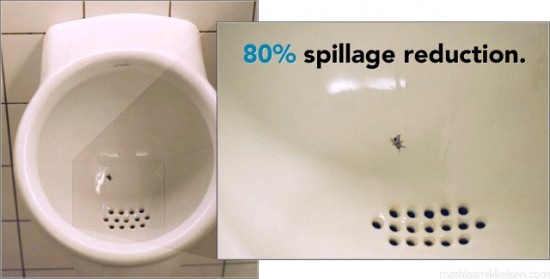
In theri brilliant book Nudge, authors Richard H. Thaler and Cass R. Suntein cite some fascinating examples of the way small and seemingly insignificant details can have a major impact on behavior. The men's restrooms at Schiphol Airport in Amsterdam are a good example. When the restroom designer etched the image of a black houselfly into each urinal, it reduced spillage by 80 percent. According to Aad Kieboom, the man who came up with the idea, "If a man sees a fly, he aims at it."
I love that. It makes me wonder: What small and seemingly insignificant actions or behaviors or attitudes could transform our lives in significant ways?

We often think that big things make the biggest difference. What if that's wrong? What if we could do a few small and seemingly insignificant things? 

Here are some ideas: Read the Bible each day. Talk with God throughout your day. Limit your time on social media. Add some silence to your day. Say no. Say yes.

What's a small thing that could make a big difference for you?

While we're figuring that out I think it might be time for those of us with boys at home to etch some flies into our toilets.

Tuesday, September 09, 2014

A glimpse into the world of boys


Anybody that has boys, or works with boys, has wondered at one time or all the time, “What is going on in their head and in their world?”

Rosalind Wiseman gives us a glimpse in her book Masterminds and Wingmen.

As a father of three boys who wants to be a better father of my boys, this book is both fascinating and helpful. It’s fascinating in the sense that it gives those of us outside of boy world a glimpse into boy world. It’s helpful in that if gives practical advice about how to handle the plethora of boy world issues that our boys face on a daily basis.

She covers topics like gaming, girls, sports, the pressures that come from the Act-Like-A-Man-Box and the hierarchy that exists in boy world. Some of the topics were very relevant to my family situation. Others were interesting but not all that helpful. I didn't agree with everything she said or recommended, but that doesn't take away the value of this book which is why I highly recommend it for all parents of boys and anyone who works with boys on a regular basis.

An added bonus is her free book called The Guide for teen boys. I downloaded it for my boys and one of them has already devoured all 300+ pages. 

I need to make a disclaimer: I am a follower of Jesus, a Christian. For my fellow Christian friends: Neither of these books are written from a Christian perspective. I don't think that's a problem, but it is something you need to know, especially if you encourage your son to read The Guide. I'm not afraid of my boys reading stuff from a non-Christian perspective. I don't think you should be either. But I do think it's important to talk about different world views.

I received this book from Blogging for Books for review.

Thursday, September 04, 2014

Don't give up on growth

I read this devotion from Rick Warren today and it was too good to keep to myself.


“Do not let any part of your body become an instrument of evil to serve sin. Instead, give yourselves completely to God, for you were dead, but now you have new life. So use your whole body as an instrument to do what is right for the glory of God.” (Romans 6:13 NLT)
Have you ever wondered why doesn’t God answer your prayers immediately? There are a couple of reasons.
The first reason is that he wants to know if you’re really serious. There’s a difference between a desire and a whim. When you have preschoolers you learn this. They ask, “Daddy, can I have this?” You answer, “No,” and they forget it. If they keep saying it over and over, it’s not a whim; it’s a desire.
God doesn’t answer whims. If you don’t care about praying about it more than once, it’s a whim. So God wants to see if you really mean business.
The second reason is that God is not a vending machine where you put in a prayer and the answer immediately pops out. God doesn’t serve you; you serve him.
If God answered every one of your prayers instantly, you would be the most self-centered person on the planet. Remember the movie “Bruce Almighty”? Jim Carrey’s character was given the ability to get anything he prayed for instantly. Whatever he asked for, he got it. He basically ruled the world! He also turned into a pretty terrible person.
You know the mess you’re in right now? You didn’t get into it instantly. You didn’t just make one bad choice; you made a lot of bad choices. So God has to peel the onion, one layer at a time.
If you’re serious about letting God change your life, you’ve got to hang on and not give up until God blesses you. Most people miss God’s best because they give up too soon. They give up in the struggle.
Don’t do it. Commit to God changing you — in his time. Don’t let go until he chooses to bless you.
Recovery is a process. Healing is a process. Growth is a process. It’s not a one-time event.
The Bible says in Romans 6:13, “Do not let any part of your body become an instrument of evil to serve sin. Instead, give yourselves completely to God, for you were dead, but now you have new life. So use your whole body as an instrument to do what is right for the glory of God” (NLT).

Tuesday, September 02, 2014

Maybe we should write a marriage book

I have read that everyone has a book in them. I'm not sure if I think that is true but I think I may have a book or two in me, but the question that keeps me paralyzed is, "What would I write about?"

I could write about planting a church. Actually, I have the outline of a book already written. Nathan was impressed that I have 12 chapters. But who wants to read a church planting book from someone like me? 

Liz and I celebrated our 18th wedding anniversary this past Sunday. Over and over again we heard three thing: Congrats, 18 years is a long time, and how do you do it?

I know a lot of people who are having a tough time in the marriages. Some of my good friends are separated or divorced. I saw today that an old friend of mine is separated. It breaks my heart. 

We don't have a perfect marriage. There's no such thing. But I love my marriage. I love being married. And I love Liz. 

All this got me thinking that maybe we have something from our experience to share. 

So maybe we should write a marriage book. It's just an idea. In the meantime, if you need advice, ask. I would love to chat with you.

Thursday, August 28, 2014

Another reason to be a Clemson fan

The wait is over. College football starts tonight! For those of you (not to mention any names, Mike Adler...) who are still unsure who you should support let me share the follower WSJ article and graphic. Go Tigers!!!

Following three consecutive 10-win seasons, including back-to-back top 10 finishes on the field, coupled with four straight years ranked among the top 10 percent in the NCAA’s Academic Progress Report, Clemson football again is perched in the top right corner of the Wall Street Journal’s grid of “admirable” and “powerhouse” programs.

(The WSJ grid is available HERE - WSJ Chart

Clemson is the only FBS program nationally to finish each of the last three seasons in the top 25 of both polls on the field, and in the top 10 percent of APR scores in the classroom. Clemson and Stanford are the only two FBS programs with a top 10 final ranking in the USA Today Coaches poll and a top 10 percent ranking in FBS APR scores each of the last two years.

The Journal places teams across an x-axis based upon on-field success with a y-axis correlated to off-field reputation. According to the article:

We decided the thin line between admirable and embarrassing with a weighted calculation of every team's academic performance, NCAA violation and probationary record, attendance figures, off-season arrests, total funding it takes from the university or state and amount that student fees subsidize the athletic department.

This is the Wall Street Journal’s fourth annual grid, and Clemson has been in the top right quadrant each of the last two years.